
On March 22, 2022, we are publishing a wild, fearless novel called My Volcano by John Elizabeth Stintzi. A kaleidoscopic portrait of a menagerie of characters, as they each undergo personal eruptions, while the Earth itself is constantly shifting, My Volcano is a parable, myth, science-fiction, eco-horror, and radical work literary art.
"A fever dream that whirs together homicide statistics from 2016 with an array of outlandish science fiction tropes. An allegory about the mutability of all things. An unsettling meditation on the 21st century’s strange reality. An apocalyptic phantasmagoria where bizarre kaiju roam the lands and wreak havoc. A lyrical treatise on volcanoes as metaphors. A wild ride. Future students of My Volcano... will offer myriad theses about the true nature of the author’s stupendous book. The unfettered abundance, uniqueness and irreducibility of My Volcano will likely encourage as many interpretations as the book has readers." —Brett Josef Grubisic, The Toronto Star
My Volcano is also the first winner of the Sator New Works Award, which was made possible through Sator Press, which was operated by Ken Baumann for a decade. We are thrilled to continue Sator's tradition of publishing innovative literature through this prize.
Following is an interview with JES about My Volcano and making art during wartime.
Q: You weave together many disparate threads in My Volcano, from a young boy transported from present-day Mexico City to the time of the Aztecs, to a Nigerian scholar of volcano myths in Tokyo, to a transgender director of lemonade commercials from Hawaii. Was that international and exceptionally broad point-of-view an approach that arrived hand-in-hand with the subject of the story?
JES: As soon as My Volcano really began to present itself as a novel, I wanted it to take place globally, and so obviously with the globe comes the diverse and broad point-of-view the reader finds in the book. I wanted the narratives collected here to feel almost disparate, while overlapping in particular ways. So I’d say yes: setting the stories of these characters in all these different places was something I was trying to do from the get-go.
Q: My Volcano is one of the rare books, where I feel as though you went all in as an author, unafraid of self-reproach or censorship. There are buildings walking around on animal legs, time travel, golems, and colors that animate. Since the story feels very unleashed, I’m curious whether there were any parameters you did set for yourself in writing the book?
JES: I did really let myself try pretty much anything in the writing of this book. In many ways, it was the book I would cheat on my other books with, and in particular it was a space I would turn to when I was frustrated—either with my other projects, or with the world in general. The only parameter I think I placed on myself is the same one that dictates all of my fiction: everything that happens should be believable. Which may sound absurd, given the examples you’ve noted, but because the first page of My Volcano has a volcano rising from the center of Central Park, the world of the story doesn’t share the same parameters for believability than one might think of in “realist” fiction. But with each element you’ve noted, no matter how strange they may be, once introduced into the novel, fits in a way that—I hope, at least—feels believable to the reader.
Q: As I’ve read through the manuscript a couple times, I’ve told a few folks about the story, and I don’t believe I’ve described it the same way twice. (Which, admittedly, is something I need to work on as editor.) Even when I feel as though I touch on many of the story threads, I realize that I’m missing just as many. Did anyone, from early readers to friends you may have mentioned the book to, suggest you might drop a character or reel something in?
JES: I love that, it’s not a book that I really know how to describe in one way, either, so I think part of it is that it’s just a strange vessel that’s difficult to describe, and that a reader may just need to experience. In terms of people suggesting I drop things or reel things in, I would say that no one really majorly gave me that kind of feedback. There were a lot of tonal misadventures that Tony Wei Ling (Nat. Brut’s fiction editor) helped identify for me early on, and my friend Jonathan Wlodarski helped me come to terms with majorly revising a meta-fictional character who had been living in 2019 rather than 2016 (when the major actions of the novel take place), which was very distracting. My agent, Stephanie Sinclair, did goad me into dropping a character who was formerly introduced way too close to the end of the book, and whose existence was then replaced by a new significant character that I added during the last pre-submission pass of the book (that new character being Ash, the transgender director of the lemonade commercials that appear in the book). On a whole, I think all my readers understood what I was doing with the book, and that the book does a good job—I hope—of setting the tone early that it would have a vast cast of characters, both major and minuscule.
Q: As a Canadian living in the United States—especially during the Trump administration and during COVID—how did that impact the writing of My Volcano?
JES: I’m actually a dual citizen of both Canada and the US, which I think caused a particular turbulence about the state of this country and my place within it, and the relative ease with which I could escape it should I have decided to.
Trump’s influence on my book (which is set in the summer of 2016, before he was elected) was largely in trying to posit that his election wasn’t as unbelievable as many of us (myself included) felt that night in November, but instead resulted largely because so many of us hadn’t bothered to pay enough attention to what had been going on for a very long time—which are themes that definitely speak to the book. I definitely wanted to consciously keep him out of the book, though, because I wanted to portray what it has felt like to live in the world, which are feelings which he magnified rather than gave birth to. But as I noted in an earlier question, this was a book that was really fueled by my frustrations, so living through Trump’s presidency gave plenty of fodder for that. COVID, as well as the summer of also-too-believable murders of Black Americans by police (& the rampant police violence at peaceful demonstrations), came at the end of the writing process for me, which I’m actually very thankful for, because I feel like had they had happened earlier in the process, when the trajectory of the book wasn’t yet set in stone (although my book was already noting that the summer of 2016 was ripe with police murders of innocent Black Americans, among other losses) these events might have taken over the book. Writing My Volcano was actually the thing that helped me most in those early months of COVID, giving me a place to escape to—strange and angry place that it is!—as I came to terms with the ways COVID was going to affect my life, and particularly the lives of the two books I was about to launch into the world. But COVID and the protests surrounding Black Lives Matter did help me think more clearly about the ways that both contagion and protest feature in the book.
Q: My Volcano opens with a protrusion growing in the Central Park reservoir, which continues to grow and is discovered to be a volcano. Later, continents shift, and cities are destroyed and come together. Many of the characters are going through their own growth, in sexuality, gender, and relationships. How did you conceive of this thought of filtering character emotions through landscapes and events?
JES: Most of that came from an early intention to meditate on the idea of eruption: thinking about how many things have been shifting for a long time—in the body, in society, in the Earth—and how they end up erupting if not properly addressed.
Q: The story—while touching on violence against individuals based on sexuality, gender, and race, as well as climate change—is sometimes optimistic and just as often not. The ending, which I obviously don’t want to give away, is brutally honest. Are you a glass half-full or half-empty person?
JES: I think I go into fiction wanting to convince myself to be a more glass half-full sort of person, and that the projects I’m most excited about are the ones that allow me to work things out to feel a bit of hope. I am definitely predisposed to pessimism, but in my writing I am always looking to try and prove myself at least half-wrong.
Q: My Volcano is told in a very cinematic manner. Are there any films or shows that you feel share an affinity with the book, or may have served as inspiration?
JES: That’s very interesting to me! I think there are several other “My” films that may have been bumbling around in my head, particularly Guy Maddin’s My Winnipeg, which has a very inspirational surreality to it, and which I think was part of the inspiration for the title. I’m also reminded of Sergei Loznitsa’s My Joy, which I watched for a class in college nearly a decade ago, and whose details I mostly don’t remember, but whose tone, minimalism, and brutal realism—as well as the haunting way it refuses to give precise shapes to its mysteries—could be in the bones of this book also.
I will also add that there are sections of the book which feel straight out of anime like Dragonball Z, Neon Genesis Evangelion, or the film Akira—particularly of the violent final clash with the aforementioned golem, which I was actively trying to channel the feeling of epic, high-stakes anime battles.
This answer makes me sound more like a film/visual media buff than I am, really, but I was also thinking a lot about the documentary Nostalgia for the Light, which is about the Atacama desert as both a location where very ambitious astronomy projects are undertaken (due to its being the driest/most cloudless place on the planet), the former home of ancient Indigenous civilizations, as well as where many of the dead and “disappeared” from Augusto Pinochet’s authoritarian regime in Chilé have been found/are thought to be buried. The influence here is both in the way the film deals with the far-away (listening to the noise of dead stars) and what is underfoot, and in the fact that it planted in me the knowledge that led to the creation of the character Joao, who works at an observatory in the Atacama.
Booksellers, critics, and librarians can request an Advance Reader Copy of My Volcano.
My Volcano is available for pre-order.
| Read more →


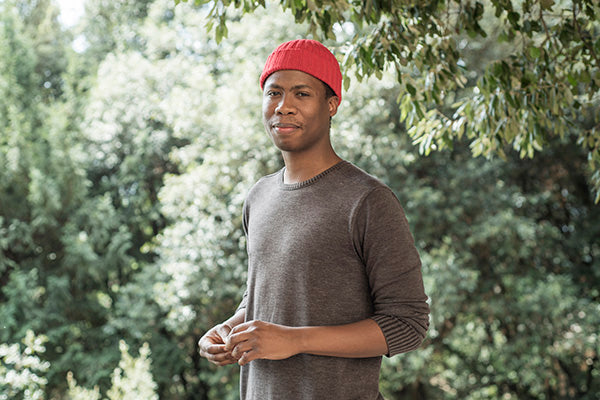
 In the fall of 2016, we were also fortunate enough to bring Masande to the U.S., for events at the Brooklyn Book Festival and City Lights Bookstore, as well as many points in between. For the Midwest leg of the tour, we drove with Masande to events throughout Ohio, Illinois, Iowa, and Wisconsin, on a trip that proved to be exceptionally fun and surprising. In Davenport, Iowa, he read in an old town hall on the banks of the Mississippi River before two folksy American bands played. In Columbus, he spoke to the radio station WOSU about South Africa's strife and where his work fit within its history. And in Fairfield, we ate Ethiopian food at a YMCA dining hall with the author of Found Audio, N.J. Campbell. The experience of hosting Masande was one of the more memorable and enjoyable experiences of my 14-year publishing experience.
 Masande Ntshanga: It’s strange. I didn’t leave anything out, which is rare. Technically, I began with the coming-of-age story, but to be honest, how it really started was that, after my first novel, I became preoccupied with the idea of the three-act narrative. Obsessed, almost. That’s where the motif of the triangle came from. In my first book, as well as in stories I’d published before, I’d always viewed both its nature and predominance with suspicion. It sounds naïve, now, but I favoured narrative voice over what I felt was a contrived and limited narrative structure. That’s what mattered to me at the time: looser structure, ambiguity, a more accurate simulation of reality, etc. But fiction can never be reality in the end. Not the reality of the senses, anyway. It can only be fiction, and that’s a strength, not a weakness, I came to realize. Once I’d made peace with that—that the three-act narrative was a valuable literary device in its own right, with enough great stories in its repertoire—I began to wonder what it would look like if I tried to befriend it. Most of the novel’s structure and drive is derived from this preoccupation, including its use of mystery, science fiction, and coming-of-age. I wanted to explore the three-act narrative using three genres, and to see what emerged on the other side. These are the book’s formal preoccupations. In terms of content, once I got going, my preoccupation with narrative structure naturally grew into a preoccupation with memory and recollection—and with time; and this idea that the imagination could be a memory of the future. Mystery, then, became a choice because of its strong adherence to the element of discovery, and science-fiction because of its adherence to speculation. The former was provident in picking apart and exploring the past, and the latter was provident in imagining the future.
 Subscribe to our feed