
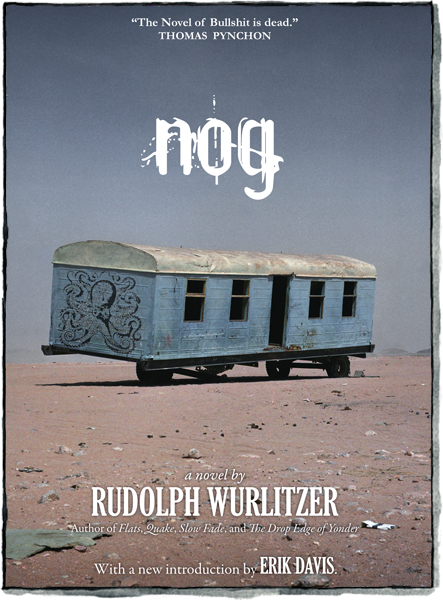


Nog
a novel by
Rudolph Wurlitzer
ABOUT
"[Nog's] combo of Samuel Beckett syntax and hippie-era freakiness mapped out new literary territory for generations to come."
—Time Out New York
Synopsis
In Wurlitzer’s signature hypnotic and haunting voice, Nog tells the tale of a man adrift through the American West, armed with nothing more than his own three pencil-thin memories and an octopus in a bathysphere.
Nog by Rudolph Wurlitzer =
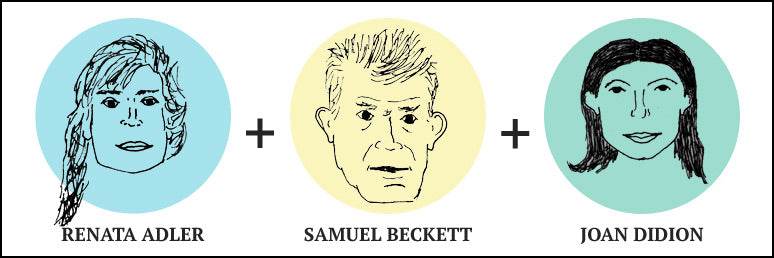
* In most cases, none of these writers endorse this book. Our math formulas are supposed to be amusing anecdotes, similar to shelf-talkers in bookstores that say "If you like X, you might enjoy Y," or "This Book is like Cormac McCarthy writing an episode of Saved by the Bell with a soundtrack by Philip Glass."
Reviews
"There is so much momentum toward the future in this cross-country journey that a reader could easily feel as though the author had pulled out the stopper to let the past and the present go rushing down the drain. In other words, the scary parts are when it starts to make sense. There is tripping, there are tattoos, there is sex with multiple partners (arms, legs, all very loving). Go West! Go East! Cowboys, Buddhists and cowboy Buddhists abound. A bit of Jack Kerouac, a bit of James Joyce in the moments of revelation when the clouds part... This is not the '60s of sweet kids and folk music; nor is it sinister and doomed to an irrelevant old age. The trippiness contains an Ariadne's thread to something older and more meaningful: an effort to break free, a hero's tale."
—Los Angeles Times
"An essential piece of '60s literature that remains as crunchy and toothsome yet unsettling a nonpareil as it registered upon its debut. Nog's capricious West Coast encounters with a host of American purebreds, from the hippies Lockett and Meridith to the right-wing gun nut Bench, all couched in droll vernacular, provides a constant impetus to turn page after page in this surreal California phantasmagoria."
—Barnes & Noble Review
"Nog—part quest novel, part Western, part artifact of late-'60s acid culture—pushes the boundaries of selfhood in a highly readable and often hilarious way."
—Village Voice
"Wurlitzer is working on some strange, big stuff that only novelists in the '60s—and Denis Johnson—were allowed to do. One can't ever be sure of anything in Nog, except that the delirium has aged well."
—Time Out Chicago
"Nog is no airport novel. Nog is a subtle and nomadic book, a great counterforce to the loud, sentimental, novels of bullshit that take up so much space in today's literary landscape."
—The Rumpus
"A successful and haunting piece of experimental fiction, and a reader who has enjoyed it will press it upon others."
—Quarterly Conversation
"Wurlitzer is a true American master of literary form. If all art is at once surface and symbol, as Oscar Wilde suggests in the preface to Picture of Dorian Gray, then Wurlitzer's 1969 debut novel is the ultimate expression of that statement, a writhing copperhead snake that is difficult to hold onto but spellbinding to observe in its raw, natural beauty."
—PopMatters
"Reading Nog is akin to reading other counterculture books of the era, particularly the works of Richard Brautigan. That Nog continues to endure is a sign that the novel transcends its existence as a cultural artifact to emerge as a work of continuing resonance."
—Powell's Review-a-Day
Author

Rudolph Wurlitzer is the author of the novels Nog, Flats, Quake, Slow Fade, The Drop Edge of Yonder, and a non-fiction book, Hard Travel to Sacred Places. He has written numerous screenplays, including Pat Garrett and Billy the Kid, Two Lane Blacktop, and Walker.
Erik Davis (Introduction) is an American writer, scholar, journalist and public speaker whose writings have ranged from rock criticism to cultural analysis to creative explorations of esoteric mysticism. He is perhaps best known for his book Techgnosis: Myth, Magic and Mysticism in the Age of Information, as well as his work on California counterculture, including Burning Man, the human potential movement, and the writings of Philip K. Dick.
Info
LIST PRICE: $15.50
PAGES: 162
PRINT ISBN: 9780982015124
EBOOK ISBN: 9781953387622
RELEASE DATE: 9/1/2009
INTRODUCTION: Erik Davis
AUDIO BOOK: Audible.com offers the audio version of Nog
FOREIGN LANGUAGE:
Underwood Editions (Spanish) version of Nog











Be the first to know! Click to visit the Newsletters page to sign up for the Two Dollar Radio newsletters.
Hi there!

Latest posts
-
Q+A with Brenda Iijima about Shelter Is Necessary for Existence
In October 2026, we are proud to be publishing Brenda Iijima's second novel, Shelter Is Necessary for Existence, a work of social satire wrapped in the patina of a psychological thriller. Narrated by the matriarch of an affluent family in... Read more →
-
Q+A with Nora Lange about Day Care
In September 2024, we released Us Fools, the debut novel by Nora Lange, which went on to be a Los Angeles Times bestseller, a best book of the year at The Boston Globe and NPR, and win the Sue Kaufman Prize... Read more →
-
Zachary Pace in Columbus, Ohio
Introduction by Brett Gregory: Zachary Pace is the author of I Sing to Use the Waiting: A Collection of Essays about the Women Singers Who've Made Me Who I Am. This book is special. It's accessible and informative, yes, but it's... Read more →